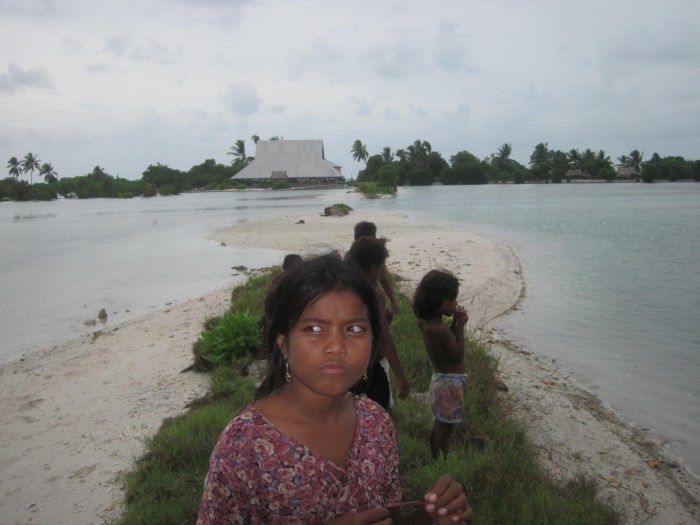
The kids are always the first to spot what’s coming. They have safety in numbers, proceeding in a pack out of the palm shadows to the edge of the beach to eventually wave abundantly at us I-Matang in our funny hats riding ashore in a rubber boat with wheels.
Mao was the eldest, tall and teethy, with a dramatic swath of black hair. She didn’t know what we wanted, but we didn’t know what we wanted either. We rowed ashore because it’s what you do when you anchor off a village; this one just happened to be far off the well-sailed paths and they seemed baffled by our sudden appearance. We were at the very northern tip of Abaiang, an atoll just 30 miles from Tarawa, the main island of western Kiribati.

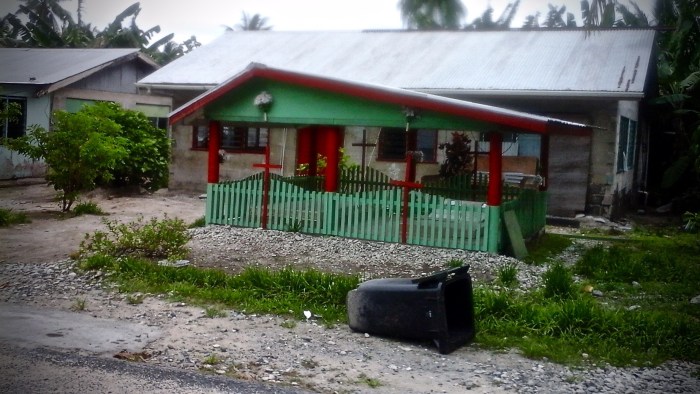 In Funafuti, in front of most homes there are large, long, cement boxes, sometimes neatly tiled, sometimes painted bright reds and greens and blues and pinks, sometimes festooned with garlands of plastic hibiscus, sometimes accompanied by carved crosses. Graves. All are big enough to house a human, the last remains of past family members, kept close to their future generations.
 CAPTAIN MORGAN OUT ISLAND